
.
.
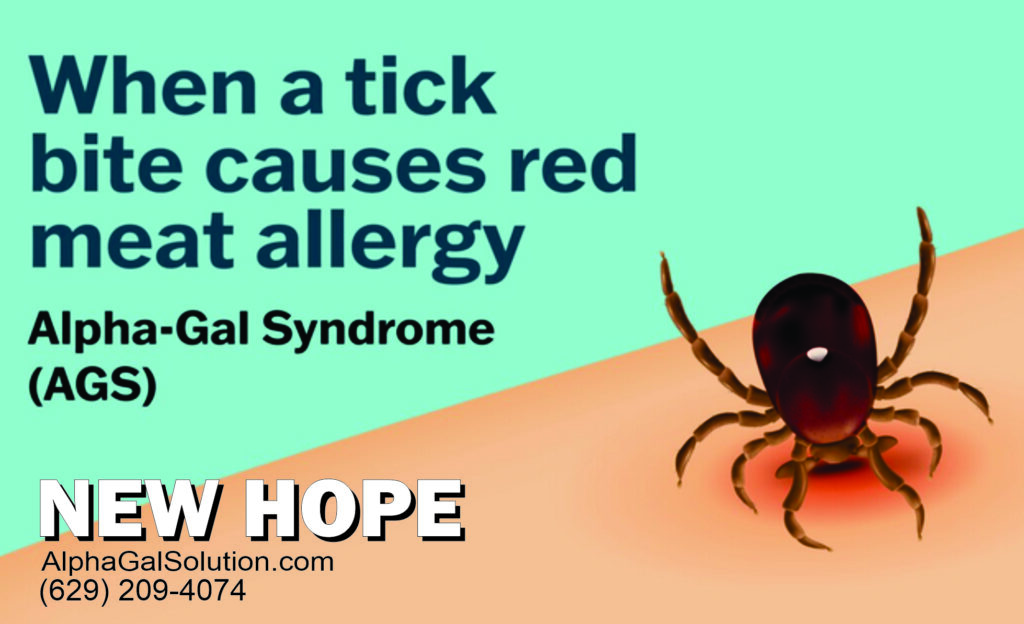
Alpha Gal Syndrome is a form of meat allergy that develops after a bite from the Lone Star Tick
.
What is Alpha Gal?
.
Alpha-gal stands for galactose-alpha-1,3-galactose. It is a carbohydrate (sugar) molecule naturally found in the cells of most mammals (such as cows, pigs, and sheep), but it is not found in humans, primates, birds, or fish.
.
When a person is bitten by certain ticks (like the Lone Star tick in the US), these ticks can transmit the alpha-gal sugar into the human body. This can trigger the immune system to create antibodies against the alpha gal sugar, resulting in Alpha-gal Syndrome (AGS). People with AGS suffer allergic reactions (which can range from hives to anaphylaxis) after eating red meat, dairy products, or consuming products derived from mammals. Because reactions can be delayed by 2 to 10 hours after eating, the allergy can be difficult to diagnose. Alpha Gal Syndrome is believed to be significantly under-diagnosed.
.
.
What changes in my body to cause me to react to meat?
.
That is a very important question to understand. Because something has changed to make your body react to something that is not really a danger (Alpha Gal molecule), it may be possible for that change to be reversed. That is the underlying concept behind treatment to help your body “flip the switch” again that caused the body to react defensively to a harmless carbohydrate molecule.
.
Before the tick bite, affected people could easily eat and digest meat and dairy. After the Alpha Gal condition has developed, they are no longer able to eat meat or sometimes dairy without a reaction. What changed, exactly?
.
When the tick bit you, it injected some of its saliva. The saliva contains Alpha Gal. Your body then reacts to the Alpha Gal as a foreign invader and mounts an emergency defense attack. That attack is part of your body’s immune system response to protect you from bacteria, viruses and other possible infections.
.
Your defense includes reactive inflammation, swelling, possibly hives, and other responses. In some cases, though, the immune reaction may be so subtle that is it not even noticed by the person that has just been bit.
.
The meat allergy comes later. The Alpha Gal sugar molecule is also contained in meat and dairy. Although meat and dairy are not a threat to your body, the immune system has now been sensitized to the sugar molecule Alpha Gal. Since the meat and dairy contain Alpha Gal, it sets off an emergency defense reaction again. Because the meat or dairy can contain much more Alpha Gal than a tick bite, the reaction can be quite many times greater.
.
.
Why is there a delay after I eat meat before I react?
.
When you eat meat or dairy, it takes some time to digest the food before your body will react.
The digestive reaction that causes stomach pain, nausea, vomiting, or diarrhea can be delayed by 1-6 hours.
.
Are reactions possible even without eating meat?
.
Although it is called “the meat allergy,” Alpha Gal involves much more. People with AGS can react to meat products from beef, pork, lamb, venison (deer) or other mammals. They may be reactive to the Alpha Gal molecules contained in dairy products. They may also react to certain drugs, notably some blood thinners and cancer drugs. Even gel caps and other products including candies that contain gelatin can cause a reaction. (gelatin is made from animal products).
.
People may also react to alpha-gal present in certain vaccines, medications, medical products, and personal care items made with mammal-derived components. A small percentage of people with alpha-gal syndrome will even experience symptoms when they are in the presence of fumes from grilling due to inhalation of meat fat droplets.
.
Some people that work around animals such as veterinarians, farm workers, and others may experience reactions due to the presence of the Alpha Gal in the animals’ dander, secretions, or blood.
.
What do allergists recommend for Alpha Gal ?
.
Allergists recommend people with AGS completely avoid all mammal meat and dairy. It is also recommended to avoid ingesting any products such as the affected medications, gelatin or other products that may be contaminated with mammal meat.
.
Because there are so many food products that may contain ingredients that can set off a reaction, this is a problem. Even is you are careful, accidental exposure can result in a reaction.
.
Alpha Gal is naturally present in many mammal-derived pharmaceuticals and medical devices, including collagen sutures, some vaccines, anesthetics, and IV solutions. Even bandages can cause problems if they’re made with mammal-derived adhesives.
.
Is there any medical treatment for AGS?
.
There is no drug or other traditional medical treatment currently available to treat Alpha Gal Syndrome. Currently the only recommendation provided by most medical providers is to avoid eating meat or dairy and being exposed to the products that cause a reaction. Medically, Alpha Gal Syndrome is considered a lifetime allergy. Although some patients may eventually be able to resume safely eating meat again, others will not.
.
Currently the only medical treatment that has been effective in helping patients with Alpha Gal Syndrome begin to eat meat again is Medical Acupuncture
.
.
Learn more about our effective NAAT Medical Acupuncture treatment program in this website.
Or call to request a FREE Initial Consultation.
.
.
Tips For Avoiding Tick Bites
CDC Recommendations for How To Prevent (Lone Star) Tick Bites
Before You Go Outdoors
- Know where to expect ticks. Ticks live in grassy, brushy, or wooded areas, or even on animals. Spending time outside walking your dog, camping, gardening, or hunting could bring you in close contact with ticks. Many people get ticks in their own yard or neighborhood.
- Treat clothing and gear with products containing 0.5% permethrin. Permethrin can be used to treat boots, clothing and camping gear and remain protective through several washings.
- Use Environmental Protection Agency (EPA)-registered insect repellents containing DEET, picaridin, IR3535, Oil of Lemon Eucalyptus (OLE), para-menthane-diol (PMD), or 2-undecanone. EPA’s helpful search tool can help you find the product that best suits your needs. Always follow product instructions.
- Do not use insect repellent on babies younger than 2 months old.
- Do not use products containing OLE or PMD on children under 3 years old.
- Avoid Contact with Ticks
- Avoid wooded and brushy areas with high grass and leaf litter.
- Walk in the center of trails.
Click to visit sponsor
After You Come Indoors
- Check your clothing for ticks. Ticks may be carried into the house on clothing. Any ticks that are found should be removed. Tumble dry clothes in a dryer on high heat for 10 minutes to kill ticks on dry clothing after you come indoors. If the clothes are damp, additional time may be needed. If the clothes require washing first, hot water is recommended. Cold and medium temperature water will not kill ticks.
- Shower soon after being outdoors. Showering within two hours of coming indoors has been shown to reduce your risk of getting Lyme disease and may be effective in reducing the risk of other tickborne diseases. Showering may help wash off unattached ticks and it is a good opportunity to do a tick check.
- Check your body for ticks after being outdoors. Conduct a full body check upon return from potentially tick-infested areas, including your own backyard. Use a hand-held or full-length mirror to view all parts of your body. Check these parts of your body and your child’s body for ticks:
- Under the arms
- In and around the ears
- Inside belly button
- Back of the knees
- In and around the hair
- Between the legs
- Around the waist
- Examine gear and pets. Ticks can ride into the home on clothing and pets, then attach to a person later, so carefully examine pets, coats, and daypacks.
Source: CDC